Movember at ForgeRock

I heard of the Movember movement last year when my friend Pat aka @Metadaddy filled my twitter stream with his moustachy face. I quickly noticed other people growing a moustache, including the Grenoble hockey team : Les Bruleurs de Loups.

So this year, when Andrew Forrest suggested that we create a ForgeRock team for Movember, I didn’t hesitate much, joined, and recruited other coworkers for the French team. I told my wife beforehand and she was not really enthusiastic about the idea of a moustache on my face. But my middle daughter was encouraging me to participate and help improve men’s health research and awareness.

mo_strip


We’re reaching the end of Movember, and the moustache has grown. My wife hates it… So help me proving her that it was worth suffering and make a donation to our team.

OpenDJ Contact Manager for Android

With OpenDJ 2.6.0, we’ve introduced a new way to access your directory data, using HTTP, REST and JSon. The REST to LDAP service, available either embedded in the OpenDJ server or as a standalone web application, is designed to facilitate the work of application developers. And to demonstrate the interest and the ease of use of that service, we’ve built a sample application for Android : the OpenDJ Contact Manager

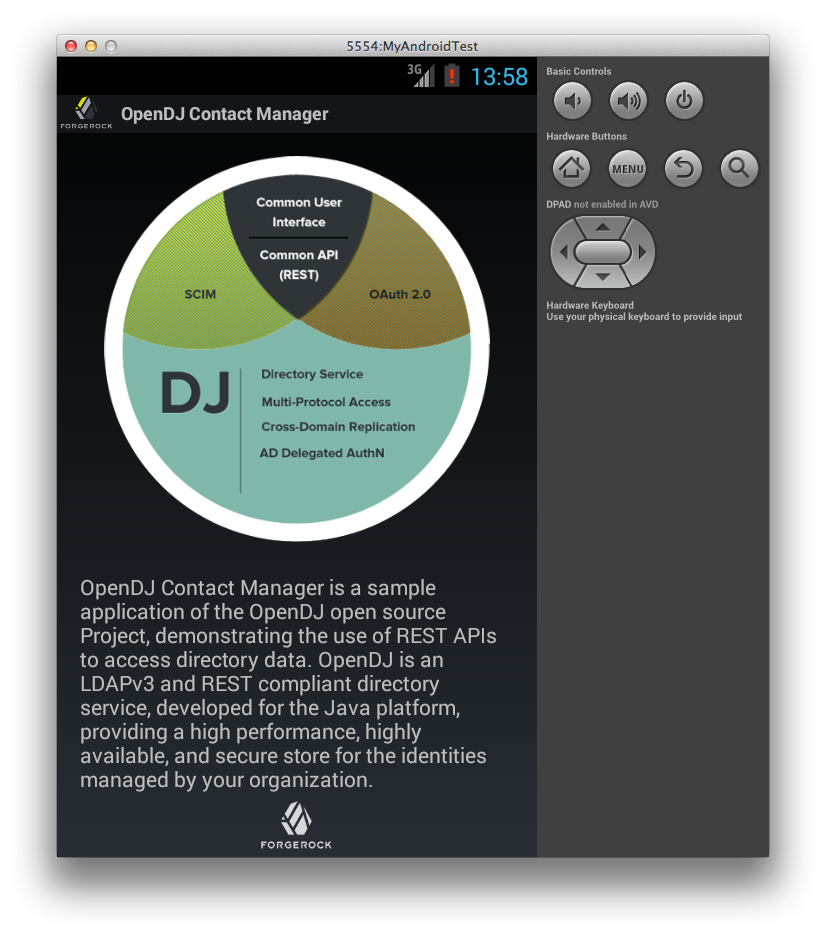
OpenDJ Contact Manager Android AppAbout screen of the OpenDJ Contact Manager Android App

The OpenDJ Contact Manager is an open source Android application that was built by Violette, one of the ForgeRock engineer working in the OpenDJ team. You can get the source code from the SVN repository : https://svn.forgerock.org/commons/mobile/contact-manager/trunk. Mark wrote some quite complete documentation for the project, with details on how to get and build the application. He published it at http://commons.forgerock.org/mobile/contact-manager/.

The whole application is just about 4000 lines of code, and most of it is dealing with the display itself. But you can find code that deals with asynchronous calls to the OpenDJ rest interface, with paging through results, and parsing the resulting JSON stream to populate the Contacts, including photos. Et voila :

OpenDJ Contact Manager displaying a Contact

The application is just a sample but it clearly is usable in its current form and will allow once a contact was retrieved from the OpenDJ directory, to add it to the Contacts standard application, call the person, locate its address on maps, send the person an email, navigate through the management chain…

In future versions, we are planning to add support for OAuth 2.0, removing the need to store credentials in the application settings.

As it’s open source, feel free to play with it, hack and contribute back your changes.

LDAPCon 2013 – a summary…

ldapcon_2013_logo_line_dateLast Monday and Tuesday (Nov 18-19), I was in Paris attending the 4th International LDAP Conference, an event I help to organize with LDAPGTF, a network of French actors in the LDAP and Identity space. ForgeRock was also one of the 3 gold sponsors of the conference along with Symas and Linagora.

LDAPCon 2013The conference happens every other year and is usually organized by volunteers from the community. This year, the French guys were the most motivated, especially Clément Oudot from Linagora, leader of the LDAP Tool Box and lemonLDAP projects, and Emmanuel Lecharny one of the most active developers on Apache Directory Server.

I was honored to be the keynote and first speaker of the conference and presented “The Shift to Identity Relationship Management“, which was well received and raised a lot of interest from the audience.

The first day was focusing more on the users of LDAP and directory services technologies, and several presentations were made about REST interfaces to directory services, including the standard in progress: SCIM.

Kirian Ayyagari, from the Apache Directory project, presented his work on SCIM and the eSCIMo project. Present for the first time at LDAPCon, Microsoft’s  Philippe Beraud spoke about Windows Azure Active Directory and its Graph API. And I talked about and demoed the REST to LDAP service that we’ve built in OpenDJ. For the demo, I used PostMan, a test client for HTTP and APIs, but also our newly open sourced sample application for Android : OpenDJ contact manager. In the afternoon, Peter Gietz talked about the work he did around SPML and SCIM leveraging OpenLDAP access log.

After many talks about REST, we had a series of talk around RBAC. Shawn McKinney presented the Fortress open source IAM project and more specifically the new work being done around RBAC. Then Peter, Shawn and Markus Widmer talked about the effort to build a common LDAP schema for RBAC. And Matthew Hardin talked about the OpenLDAP RBAC overlay bringing policy decisions within the directory  when deploying Fortress.

Then followed presentations about local directory proxy services for security based on OpenLDAP, about Red Hat FreeIPA (another first appearance at LDAPCon) and about OpenLDAP configuration management with Apache Directory Studio. Also Stefan Fabel came all the way from Hawaii ( Aloha ! ) to present a directory based application for managing and reporting publications by a university: an interesting story about building directory schema and data model.

The day ended with a presentation from Clement Oudot about OpenLDAP and the password policy overlay. As usual, talking about the LDAP password policy internet-draft raises the question of when it will be finally published as an RFC. While there is a consensus that it’s important to have a standard reference document for it, I’m failing to see how we can dedicate resources to achieve that goal. Let’s see if someone will stand up and take the leadership on that project.

After such a long day of talks and discussion, most of the attendees converged to a nearby pub where we enjoyed beers and food while winding down the day through endless discussions.

The second day of LDAPCon 2013 was more focused on developers and the development of directory services. It was a mix of status and presentations of open source directory projects like OpenDJ, OpenLDAP or LSC, some discussions about backend services, performance design considerations and benchmarks, a talk about Spring LDAP… As usual, we had a little bit of a musical introduction to Howard Chu‘s presentation.

LP0_1068I enjoyed the Benchmark presentation by Jillian Kozyra, which was lively, rational and outlining the major difference between open source based products and closed source ones (although all closed source products were anonymized due to license restrictions). It’s worth noting that Jillian is pretty new in the directory space and she seems to have tried to be as fair as possible with her tests, but she did say that the best documented product and the easiest one to install and deploy is OpenDJ. Yeah !!! 🙂

Another interesting talk was Christian Hollstein‘s about his “Distributed Virtual Transaction Directory Server“, a telco grade project he’s working on to serve the needs of the 4G network services (such as HSS, HLR…). It’s clear to me that telco operators and network equipment providers are now all converging to LDAP technologies for the network and this drives a lot of requirements on the products (something I knew since we started the OpenDS project at Sun, kept in mind while developing OpenDJ, even though right now our focus has mainly been on the large enterprises and consumer facing directory services).

All the slides of the conference have been made available online through the LDAPCon.org website and the Lanyrd event page. Audio has also been recorded and will be made available once processed. And as usual, all the photos that I took during the conference are publicly available in my Flickr LDAPCon 2013 Set. Feel free to copy for personal use.

It’s been a great edition of the LDAPCon and I’m looking forward to the next one, in 2 years !

Meanwhile I’d like to thanks the sponsors, all 75 attendees, the 19th speakers and the 2 organizers I had not mentioned yet : M.C. Jonathan Clarke and Benoit Mortier.

Updates to opendj-utils

About a year ago, I’ve introduced a set of OpenDJ scripts and utilities that I’ve built to facilitate my work with OpenDJ.

Last week, I’ve pushed some updates to the github repository.

The first improvements are in logstat.py. I’ve added support for collecting stats about the Abandon operation, as well as some counting and reports on the errors to each operation. This allows to get a feel of how many operations failed and the error code reported.

The second update is a new utility names filterstat.py which scans through access log files and builds a sorted list of all filters used in search requests. The filters are generalized and collated together, and the result should help administrators to understand which attributes should be indexed and what kind of index are required.

Here’s a sample output of filterstat (based on an instance of OpenDJ used by OpenAM). The first value is the count and the string is the generic representation of the filter:

$ ~/opendj-utils/filterstat.py access
processing file: access
213783 (&(uid=VALUE)(objectclass=VALUE))
2080 (&(|(sunxmlKeyValue=VALUE)(sunxmlKeyValue=VALUE))(|(sunxmlKeyValue=VALUE)(sunxmlKeyValue=VALUE))(|(sunxmlKeyValue=VALUE)(sunxmlKeyValue=VALUE)(sunxmlKeyValue=VALUE)(sunxmlKeyValue=VALUE)(sunxmlKeyValue=VALUE)(sunxmlKeyValue=VALUE)))
807 (&(objectclass=VALUE)(uniqueMember=VALUE))
244 (&(cn=VALUE)(objectclass=VALUE))
213 (&(&(uid=VALUE)(objectclass=VALUE)))
140 (&(|(sunxmlKeyValue=VALUE)(sunxmlKeyValue=VALUE))(|(sunxmlKeyValue=VALUE)(sunxmlKeyValue=VALUE))(|(sunxmlKeyValue=VALUE)(sunxmlKeyValue=VALUE)(sunxmlKeyValue=VALUE)(sunxmlKeyValue=VALUE)(sunxmlKeyValue=VALUE)))
63 (&(|(sunxmlKeyValue=VALUE)(sunxmlKeyValue=VALUE))(|(sunxmlKeyValue=VALUE)(sunxmlKeyValue=VALUE)(sunxmlKeyValue=VALUE)(sunxmlKeyValue=VALUE))(|(sunxmlKeyValue=VALUE)(sunxmlKeyValue=VALUE)))
39 (&(&(cn=VALUE)(objectclass=VALUE)))
6 (&(uid=*SUBSTRING*)(objectclass=VALUE))
2 (&(objectclass=VALUE)(ou=VALUE))
1 (&(&(uid=*)(objectclass=VALUE))(|(uid=VALUE)))
Base search filters only:
2487 (|(objectclass=*)(objectclass=VALUE))
Done

Please give those tools a try and let me know how useful they are for you. And if you have ideas on how to improve them, feel free to fork them and contribute.

What a great ForgeRock European Open Identity Summit !

Chateau BehoustLast week, ForgeRock hosted its first european Open Identity Summit, in the “Chateau de Béhoust” just outside Paris. For two and half days, our 110+ visitors, a mix of customers, prospect customers, partners and consultants, could attend presentations, meet and greet with ForgeRock employees, have lengthy discussions with peers, exchanging experience or use case scenarios around the ForgeRock Open Identity Stack. All of this in a very relaxed and friendly atmosphere.

All of the presentations have been filmed and will be available shortly through our web site and the summit page. If you missed the event and want to get a feel of the content, please check Simon Moffat’s review.

As usual, I’ve taken a few pictures of the event.

Thanks to all attendees and sponsors of the event. And see you next year for the second edition of our ForgeRock summits.

LP0_0488LP0_0538LP0_0595

OpenDJ is Java 8 ready…

Java 8 CompatibleA few weeks ago, I came upon the Adopt openjdk program, launched by the London Java User Group. I’ve decided to give it a try and for that to leverage the Dev@Cloud and FOSS program from CloudBees.

While building OpenDJ I hit a roadblock : XJC is defective with OpenJDK 8 and prevents us from building the DSML gateway that is part of the OpenDJ project. It’s only recently when the openjdk bug database was made publicly available that I found it was a known P1 issue, yet still not resolved.

Recently someone filed a bug against OpenDJ for failing with openjdk 8, so we paid more attention, found the cause of the failure and fixed it. And now OpenDJ directory server is working fine on openjdk 8. We are keeping an automatic build and test with openjdk8 (*) to make sure things will work when Java 8 is released.

Next steps will be to verify that OpenDJ still works with the beta version of jdk8 of IBM Java virtual machine.


* If you’re not familiar with OpenDJ nightly tests, do not try to interpret the results out there. Some of those complex replication tests are unfortunately sensitive to processor speed, thread timing and synchronization.So they tend to fail often on single CPU virtual machines where resources are unknown. They are fully passing on 2 or more CPU machines.

OpenDJ : Visualizing the Replication Topology

My coworker Chris Ridd has spent a little bit of spare time writing a small utility that can parse the output of OpenDJ monitoring information to extract the details of the replication topology. Give the output to some graphical tool and here’s the result (based on one of our biggest customer -anonymized- data) :

ReplTopo

This is a worldwide deployment with many directory services in 4 regions and 8 replication services fully connected. Each directory service is connected to a single replication server, but can failover in matter of seconds, by priority in the same region.

If you want to give it a try on your own replication topology, it’s simple. The tool is open source and part of the OpenDJ utilities that Chris has pushed to GitHub. Just feed it with the output of ldapsearch on cn=monitor.

ForgeRock Open Identity Summit comes to Europe…

Join us for the Open Identity Stack Summit Europe, on 14-16 October 2013 at the Domaine de Béhoust, France.

We will be gathering at ForgeRock’s luxe Chateau, Domaine de Béhoust (just outside Paris), where our Open Identity Stack community will delve into OpenAM, OpenIDM, and OpenDJ best practices, use cases, how-tos, and more.

We’ve been saying for a long time that identity & access management (IAM) must be reconstructed to adapt to today’s problems. Modern APIs, standards, scale, speed, and modular architecture are all needed for successful modern IAM deployments. The agenda will include dynamic working sessions addressing the latest IAM developments, including mobility, identity bridge, and customer case studies.

A call for papers is open. If you are doing something interesting with the Open Identity Stack and you would like to share the experience by presenting a session at the summit, send your proposal by September 4.

ForgeRock’s chateau is large, but registration is limited. Therefore, I encourage you to reserve your spot and register quickly !

If you want to get a feel of the atmosphere of the conference, check the photo album from the first ForgeRock Open Identity Summit or get a glimpse at the skills of one of our keynote speakers :
LP0_8856I hope to see you at ForgeRock’s chateau in October !


OpenDJ 2.6.0 is now available

OpenDJ-300x100I am really happy to announce the general availability of OpenDJ 2.6.0, a major update of ForgeRock  directory service product, built from the tag 2.6.0 (revision 9086 in our SVN repository).

OpenDJ 2.6.0 brings a lot of added value, including :

– A REST to LDAP service, allowing an easy access to directory data using HTTP/JSON. The service can be run either embedded in the server or as a standalone web application.

– A new upgrade process to ease transition from OpenDJ 2.4.5 or newer to 2.6.

– New Linux native packages (RPM and Debian) to facilitate the automatic deployment of OpenDJ in the private and public cloud.

– OpenDJ can be configured to delegate authentication to a Microsoft Active Directory service, providing tighter integration with Microsoft environment without the burden of synchronizing passwords.

– An optional extension to remove specific attributes from updates, making it more flexible and easier to deal with legacy applications and migration tasks.

– A way to synchronize SAMBA password attributes with the user’s password.

– Some improvements on the integrity of references, that is now enforced at creation or on update.

– More flexible and efficient audit logs.

– A Java based LDAP software development kit.

– An official stable documentation.

For the complete list of new features, enhancements and fixed defects, please read the release notes.

The binaries can be downloaded from ForgeRock Downloads.

Over the course of the development of OpenDJ, we’ve received many contributions, in form of code, issues raised in our JIRA, documentation… We address our deepest thanks to all the contributors and developers :

Aiman Tahboub, Alan Evans, Arturo V Sanchez, Auke Schrijnen, Bernhard Thalmayr, Brent Palmer, Bruno Vernay, Chris Dowey, Chris Ridd, Christophe Sovant, Dan Gardner, Danny Turner, Darin Perusich, Donal Duane, Elliot Kendall, Eswar Moorthy, Fred Voss, Gael Allioux, Gary Williams, German Parente, Göran Odmyr, Ian McGlothlin, Jamie Nelson, Jean-Noël Rouvignac, Jeff Blaine, Jeffrey Crawford, Jens Elkner, Lana Frost, Laurent Bristiel, Ludovic Poitou, Manuel Gaupp, Manuel Schallar, Mark Craig, Mark Gibson, Marko Harjula, Martin Sperle, Matthew Stevenson, Matthew Swift, Miroslav Fadrhonc, Mitch Silverstein, Nemanja Lukić, Nicholas Sushkin , Nikolay Belaevski, Per-Olov Sjoholm, Peter Major, Rauli Ikonen, Sachiko Wallace, Slavomir Katuscak, Tomas Forsman, Vanessa Richie, Violette Roche, Willi Burmeister

Happy 4th of July everyone !

Thanks to all participants of the 1st ForgeRock Open Identity Summit !

ForgeRock Open Identity Summit opening

I hope all attendees enjoyed the summit as much as I have. It’s been a real pleasure to meet face to face some of the project members, customers and partners I’ve interacted with, over emails and phone for the last 3 years, and to see again colleagues, ex-coworkers…

All the photos that I’ve captured during the summit are now publicly available on Flickr.

See you at the next summit !

[Update on June 19] The presentations from the summit are now online. Goto the Summit page and click on the Agenda.

LP0_8918LP0_8901LP0_8817

See you next week at the ForgeRock Open Identity Summit…

Pacific Grove, CA, photo by Jack FrenchTime is running fast and the ForgeRock Open Identity Summit is just around the corner.

For those who haven’t registered yet, I believe that there are still a few spots available : http://forgerock.com/summit/.

For the other ones, I’m looking forward to see you next week, in sunny and beautiful Pacific Grove.

Tips: Do not index virtual attributes in OpenDJ

OpenDJ-300x100OpenDJ, the open source LDAP directory service in Java, offer some interesting services to reduce and optimize the size and usage of data.

One of them is the Virtual Attribute feature, which allow certain attributes and values to be computed as needed, either based on some of the server internals or other attributes. OpenDJ ships with a number of virtual attributes by default : entryDN, entryUUID, etag, gouverningStructureRule, hasSubordinate, isMemberOf, numSubordinate, password Expiration Time (ds-pwp-password-expiration-time), structuralObjectClass, subSchemaSubEntry, …

Since these attributes are virtual and thus not stored as part of the entries in the database backend, you must not define any index for them. When possible, the virtual attribute provider will make use of default system index (like entryDN uses the DN index), but most of the time, these attributes are for reading and consuming.

If you do configure an index for one of the virtual attribute, the server will repeatedly report that the index is degraded with an error message similar to the following :

[21/Jan/2013:09:16:07 +0000] category=JEB severity=NOTICE msgID=8847510 msg=Due to changes in the configuration, index dc_example_dc_com_entryDN is currently operating in a degraded state and must be rebuilt before it can be used

And then some seaches may fail to return entries. So you must delete this index to let the server behave properly.

Making OpenDJ easier for Linux, DevOps and the cloud…

packagerpm

I’ve recently made some changes on the OpenDJ nightly builds page and made available 2 new deliveries for OpenDJ : an RPM package and a Debian package.

The goal of providing native packages for OpenDJ is to make things much easier for the Linux system administrators and the DevOps  who want to deploy OpenDJ automatically, as well as for whoever wants to run OpenDJ in a VM in the cloud.

packagedeb

There has been several other efforts to build native packages for OpenDJ, here and there, but due to the structure of OpenDJ deliveries, you could not properly upgrade versions. The packages available with the nightly builds are taking advantage of the new upgrade mechanism that has been developed, allowing an easier and smoother migration from previous releases.

If you do use the packaged version, make sure you log any bugs you find in theOpenDJ issue tracker.

I’d like to thank Danny Turner for his great contributions to the OpenDJ native packaging.

Meeting the Open Identity Stack Community

We’ve been thinking about this since the begining of ForgeRock, and we’ve finally set a date, a great location and even lined up Keynote speakers.

Join us on June 12th to 14th, 2013, in Pacific Grove, California for the first ForgeRock Open Identity Summit, an event for and with the community of the OpenAM, OpenDJ and OpenIDM projects. The agenda is still work in progress and will be previewed soon. But you can be part of it. A call for paper is opened, but not for long. You have up to May 6th to submit your proposals for presentations. Don’t wait for the last minutes !

A note on logistics, please make sure to book your hotel, registration is not complete until you’ve booked your room!  Space at Asilomar is filling up, so we encourage you to register ASAP to reserve your spot.

We’re looking forward to seeing you at the event!

reserve

Busy engineering center at ForgeRock.

Today is a very busy day at ForgeRock Grenoble engineering center, with the visit of Jamie, our VP of engineering, engineers for UK and our partner ProfiQ.

20130415-113822.jpg