OpenDJ Nightly Builds…

For the last few months, there’s been a lot of changes in the OpenDJ project in order to prepare the next major release : OpenDJ 3.0.0. While doing so, we’ve tried to keep options opened and continued to make most of the changes in the trunk/opends part, keeping the possibility to release a 2.8 version. And we’ve made tons of work in branches as well as in trunk/opendj. As part of the move to the trunk, we’ve changed the factory to now build with Maven. Finally, at the end of last week, we’ve made the switch on the nightly builds and are now building what will be OpenDJ 3, from the trunk.

For those who are regularly checking the nightly builds, the biggest change is going to be the version number. The new build is now showing a development version of 3.0.

$ start-ds -V
OpenDJ 3.0.0-SNAPSHOT
Build 20150506012828
--
 Name Build number Revision number
Extension: snmp-mib2605 3.0.0-SNAPSHOT 12206

We are still missing the MSI package (sorry to the Windows users, we are trying to find the Maven plugin that will allow us to build the package in a similar way as previously with ant), and we are also looking at restoring the JNLP based installer, but otherwise OpenDJ 3 nightly builds are available for testing, in different forms : Zip, RPM and Debian packages.

OpenDJ Nightly Builds at ForgeRock.org

We have also changed the minimal version of Java required to run the OpenDJ LDAP directory server. Java 7 or higher is required.

We’re looking forward to getting your feedback.

Linux AD Integration with OpenDJ – by Pieter Baele

This week I stumbled upon this presentation done by Pieter Baele, about the integration of Linux, Microsoft AD and OpenDJ, to build a secure efficient naming and security enterprise service.

The presentation covers the different solutions to provide integrated authentication and naming services for Linux and Windows, and described more in depth one built with OpenDJ. Overall, it has very good information for the system administrators that need to address this kind of integration between the Linux and the Windows world.

Screen Shot 2015-04-03 at 00.21.10

OpenDJ on Windows…

OpenDJ LogoOpenDJ, the LDAP directory services in Java, is supported on multiple platforms and has been for many years. We’re testing on Linux, Windows, Solaris, Mac OS X, but also different JVMs: Oracle JRE, OpenJDK, Azul Zulu, IBM JVM…

With OpenDJ 2.6, we’ve made it easier for people to install it on Linux machines by providing RPM and Debian packages.

We are now also providing a MSI package to ease the installation and removal on Windows machines. The MSI package is available for nightly builds here.

OpenDJ MSI InstallerScreen Shot 2015-01-28 at 09.14.01

A fresh look for the OpenDJ and OpenIG snapshot documentation…

OpenDJ Administration Guide ScreenshotThanks to Chris Lee, the most recent technical writer at ForgeRock, there is now a new visual design for the snapshot documentation for our open source projects.
Check it out on the OpenDJ Administration Guide, the OpenDJ SDK Developer’s Guide, the OpenIDM Integrator’s Guide or the Guide to OpenIG

Highlights of IRMSummit Europe 2014…

Powerscourt hotelLast week at the nice Powerscourt Estate, outside Dublin, Ireland, ForgeRock hosted the European Identity Relationship Management Summit, attended by over 200 partners, customers, prospects, users of ForgeRock technologies. What a great European IRMSummit it was !

If you haven’t been able to attend, here’s some highlights:

I heard many talks and discussions about Identity being the cornerstone in the digital transformation of enterprises and organizations. It shifting identity projects from a cost center to revenue generators.

There was lots of focus on consumer identity and access management, with some perspectives on current identity standards and what is going to be needed from the IRM solutions. We’ve also heard from security and analytics vendors, demonstrating how ForgeRock’s Open Identity Stack can be combined with the network security layer or with analytics tools to increase security and context awareness when controlling access.

User Managed Access is getting more and more real, as the specifications are getting close to be finalised and ForgeRock announced the OpenUMA initiative for foster ideas and code around it. See forgerock.org/openuma.

Chris and Allan around an Internet connected coffee machine, powered by ARMMany talks about Internet of Things and especially demonstration around defining the relationship between a Thing and a User, securing the access to the data produced by the Thing. We’ve seen a door lock being unlocked with a NFC enabled mobile phone, by provisioning over the air the appropriate credentials, a smart coffee machine able to identify the coffee type and the user, pushing the data to a web service, and asking the user for consent to share. There’s a common understanding that all the things will have identities and relations with other identities.

There were several interesting discussions and presentations about Digital Citizens, illustrated by reports from deployments in Norway, Switzerland, Nigeria, and the European Commission cross-border authentication initiatives STORK and eIDAS

Half a day was dedicated to ForgeRock products, with introductory trainings, demonstrations of coming features in OpenAM, OpenDJ, OpenIDM and OpenIG. During the Wednesday afternoon, I did 2 presentations on OpenIG, demonstrating the ease of integration of OAuth2.0 and OpenID Connect to protect applications and APIs, and on OpenDJ, demonstrating the flexibility and power of the REST to LDAP interface.

All presentations and materials are available online as pdf and now as videos on the ForgeRock’s YouTube page. You can also find here a short summary of the Summit in a video produced by Markus.

Powerscourt Estate HousePowerscourt Estate gardens
The summit wouldn’t be such a great conference if there was no plan for social interactions and fun. This year we had a nice dinner in the Powerscourt house (aka the Castle) followed by live music in the pub. The band was great, but became even better when Joni and Eve joined them for a few songs, for the great pleasure of all the guests.

15542471759_d6d2ee842d_m

The band15542475489_04dabb40ff_m

Slainte
Of course, I have to admit that the best part of the IRM Summit in Ireland was the pints of Guinness !

To all attendees, thank you for your participation, the interesting discussions and the input to our products. I’m looking forward to see you again next year for the 2015 edition. Sláinte !

As usual, you can find the photos that I’ve taken at the Powerscourt Estate on Flickr. Feel free to copy for non commercial use, and if you do republish them, I would appreciate getting the credit for them.

[Updated on Nov 11] Added link to the highlight video produced by Markus
[Updated on Nov 13] Added link to the slideshare folder where all presentations have been published
[Updated on Nob 24] Added link to the all videos on ForgeRock’s YouTube page

2014 European IRM Summit in only a few days away !

Starting Monday next week, at the Powerscourt Estate near Dublin, the European IRM Summit is just a few days away.

I’m polishing the content and demos for the 2 sessions that I’m presenting, one for each product that I’m managing: OpenDJ and OpenIG. Both take place on the Wednesday afternoon in the Technology Overview track.

If you’re still contemplating whether you should attend the event, check the finalised agenda. And hurry up to the Registration site ! I’m told there are a few remaining seats available, but they might not last for long!

I looking forward to seeing everyone next week in Ireland.

gardens

POODLE SSL Bug and OpenDJ

A new security issue hit the streets this week: the Poodle SSL bug. Immediately we’ve received a question on the OpenDJ mailing list on how to remediate from the vulnerability.
While the vulnerability is mostly triggered by the client, it’s also possible to prevent attack by disabling the use of SSLv3 all together on the server side. Beware that disabling SSLv3 might break old legacy client applications.

OpenDJ uses the SSL implementation provided by Java, and by default will allow use of all the TLS protocols supported by the JVM. You can restrict the set of protocols for the Java VM installed on the system using deployment.properties (on the Mac, using the Java Preferences Panel, in the Advanced Mode), or using environment properties at startup (-Ddeployment.security.SSLv3=false). I will let you search through the official Java documentations for the details.

But you can also control the protocols used by OpenDJ itself. If you want to do so, you will need to change settings in several places :

  • the LDAPS Connection Handler, since this is the one dealing with LDAP over SSL/TLS.
  • the LDAP Connection Handler, if the startTLS extended operation is to be used to negotiate SSL/TLS establishment on the LDAP connection.
  • the HTTP Connection Handler, if you have enabled it to activate the RESTful APIs
  • The Crypto Manager, whose settings are used by Replication and possibly the Pass Through Authentication Plugin.
  • The Administration Connector, which is also using LDAPS.

For example, to change the settings in the LDAPS Connection Handler, you would run the following command :

# dsconfig set-connection-handler-prop --handler-name "LDAPS Connection Handler" \
--add ssl-protocol:TLSv1 --add ssl-protocol:TLSv1.1 --add ssl-protocol:TLSv1.2 \
-h localhost -p 4444 -X -D "cn=Directory Manager" -w secret12 -n

Repeat for the LDAP Connection Handler and the HTTP Connection Handler.

For the crypto manager, use the following command:

# dsconfig set-crypto-manager-prop \
--add ssl-protocol:TLSv1 --add ssl-protocol:TLSv1.1 --add ssl-protocol:TLSv1.2 \
-h localhost -p 4444 -X -D "cn=Directory Manager" -w secret12 -n

And for the Administration Connector :

# dsconfig set-administration-connector-prop \
--add ssl-protocol:TLSv1 --add ssl-protocol:TLSv1.1 --add ssl-protocol:TLSv1.2 \
-h localhost -p 4444 -X -D "cn=Directory Manager" -w secret12 -n

All of these changes will take effect immediately, but they will only impact new connections established after the change.

Join us for the 2014 European IRM Summit, Nov 3-5 2014…

Photo by  https://www.flickr.com/photos/tochis
Photo by https://www.flickr.com/photos/tochis

There are conferences and there are Conferences. The Conferences are the ones that you remember, because they happened in unusual places, because they’ve had a different atmosphere, you’ve met lots of friendly and bright persons. They are the ones you leave with the satisfaction of having learned something, having received value, and you’re looking forward to come back next year.

The IRM Summit is one of these Conferences. The next European IRM Summit is taking place in November, 3 – 5, near Dublin, Ireland, at the Powerscourt Estate pictured here. It’s a 2 days event where you can learn and discuss about the Identity Relationship Management space, standards, platforms, solutions…There will be many presentations, demos, trainings, plenty of time for discussions and meetings, a free half day Kantara Initiative workshop around “Trusted IDentity Exchange (TIDX)”, and some fun. I can already hear the fiddle, the pipes, the harp and smell the Guinness ! And I hope the weather will let us enjoy the wonderful garden.

Check out the agenda and the list of speakers, and don’t wait until last minute to register. While there are hundreds of rooms available, they are still counted and limited. Last year’s summit was sold out !

I’m looking forward to see you in beautiful Ireland !

4 years !

ForgeRock logoFour years ago, exactly I was free from all obligations with my previous employer and started to work for ForgeRock.

My first goal was to setup the French subsidiary and start thinking of building a team to take on development of what we named a coming later OpenDJ.

4 years later, I look at where we are with ForgeRock and I feel amazed and really proud of what we’ve built. vertical-logo_webForgeRock is now well established global business with several hundreds of customers across the globe, and plenty of opportunities for growth. The company has grown to more than 200 employees worldwide and still expanding. The ForgeRock Grenoble Engineering Center has moved to new offices end of May and counts 13, soon 14 employees and we’re still hiring.

Thanks to the ForgeRock founders for the opportunity and let’s keep rocking !!!
ForgeRock CEOForgeRock CTO and Founder

Ansible roles for OpenDJ

My colleague Warren, who I had the pleasure to work with at Sun and again with ForgeRock, has been playing with Ansible and has produced 2 roles to install OpenDJ and to configure replication. Check Warren’s blog post for the details, or go directly to the Ansible Galaxy.

About LDAP Syntaxes and backward compatibility…

In the LDAP information model, a syntax constrains the structure and format of attribute values. OpenDJ defines and implements a large number of syntaxes (you can discover them by reading the ldapSyntaxes attribute from the cn=Schema entry).

But infrequently, we receive enquiries on an obscure and non standard syntax, often in the form of “I’m having an error importing schema from this or that legacy directory server”, with an error message that ends with “No such syntax is configured for use in the Directory Server”.

As syntaxes are constraining the structure and format of attribute values, they are implemented as code, specifically Java code in OpenDJ. It’s possible to implement new syntaxes by implementing the org.opends.server.api.AttributeSyntax abstract class, and installing the classes or the JAR in OpenDJ classpath. But often, it’s easier and more convenient to define a syntax by configuration, and OpenDJ offers 3 possibilities to define new syntaxes. In term of backward compatibility, I will only focus on the 2 main ones, by substitution and by pattern (the 3rd one allows to define enumeration of values).

With OpenDJ, you can define a new syntax by configuration and delegating the contraints to an already implemented syntax. A simple example is the URI syntax (which was defined is some very old schema with the OID  1.3.6.1.4.1.4401.1.1.1). A URI is really an ASCII string, and it might be sufficient to accept attributes with URI syntax to verify that all characters are pure ASCII. The standard syntax for ASCII strings is IA5String aka 1.3.6.1.4.1.1466.115.121.1.15.

ldapSyntaxes: ( 1.3.6.1.4.1.4401.1.1.1 DESC ‘URI’ X-SUBST ‘1.3.6.1.4.1.1466.115.121.1.15’ )

Insert the above line in the schema LDIF file before the attributeTypes, and you’re done.

The other option is to define the syntax as a pattern, using regular expressions. This could be better when willing to enforce additional constraints on an URI, for example, verifying that the URI is an LDAP one.

ldapSyntaxes: ( 999.999.999.1 DESC 'LDAP URI Syntax' X-PATTERN '^ldap://[-a-zA-Z0-9+&@#/%?=~_|!:,.;]*[-a-zA-Z0-9+&@#/%=~_|]' )

So the next time you are trying to import some legacy schema to the OpenDJ directory server, and you have an error due to missing syntaxes, you know what to do to quickly resolve the problem.

Save the date for the 2014 ForgeRock Identity Relationship Management Summit

The date has been set, the 2014 ForgeRock summit in United States will take place on the week of June 2nd, in Phoenix AZ.

Make sure you block the date in your calendar ! I hope to see you there.

And if you’re in Europe, don’t panic ! We are also planning an EMEA summit in the fall. The date and location will be announced later.

OpenDJ Contact Manager for Android

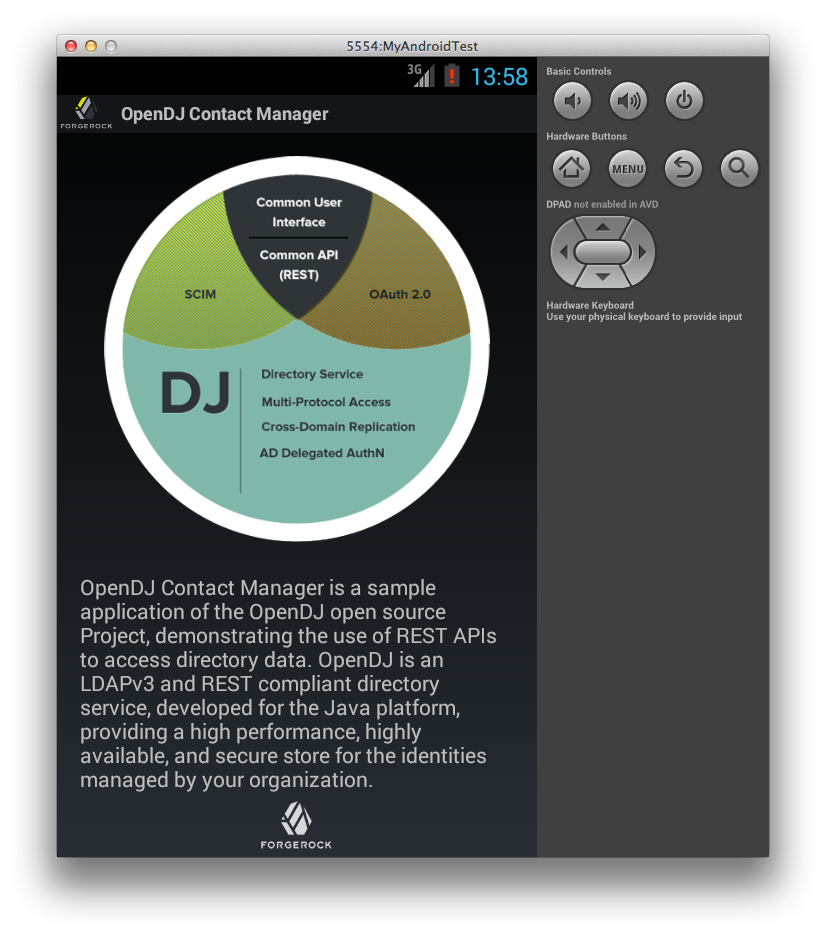
With OpenDJ 2.6.0, we’ve introduced a new way to access your directory data, using HTTP, REST and JSon. The REST to LDAP service, available either embedded in the OpenDJ server or as a standalone web application, is designed to facilitate the work of application developers. And to demonstrate the interest and the ease of use of that service, we’ve built a sample application for Android : the OpenDJ Contact Manager

OpenDJ Contact Manager Android AppAbout screen of the OpenDJ Contact Manager Android App

The OpenDJ Contact Manager is an open source Android application that was built by Violette, one of the ForgeRock engineer working in the OpenDJ team. You can get the source code from the SVN repository : https://svn.forgerock.org/commons/mobile/contact-manager/trunk. Mark wrote some quite complete documentation for the project, with details on how to get and build the application. He published it at http://commons.forgerock.org/mobile/contact-manager/.

The whole application is just about 4000 lines of code, and most of it is dealing with the display itself. But you can find code that deals with asynchronous calls to the OpenDJ rest interface, with paging through results, and parsing the resulting JSON stream to populate the Contacts, including photos. Et voila :

OpenDJ Contact Manager displaying a Contact

The application is just a sample but it clearly is usable in its current form and will allow once a contact was retrieved from the OpenDJ directory, to add it to the Contacts standard application, call the person, locate its address on maps, send the person an email, navigate through the management chain…

In future versions, we are planning to add support for OAuth 2.0, removing the need to store credentials in the application settings.

As it’s open source, feel free to play with it, hack and contribute back your changes.

LDAPCon 2013 – a summary…

ldapcon_2013_logo_line_dateLast Monday and Tuesday (Nov 18-19), I was in Paris attending the 4th International LDAP Conference, an event I help to organize with LDAPGTF, a network of French actors in the LDAP and Identity space. ForgeRock was also one of the 3 gold sponsors of the conference along with Symas and Linagora.

LDAPCon 2013The conference happens every other year and is usually organized by volunteers from the community. This year, the French guys were the most motivated, especially Clément Oudot from Linagora, leader of the LDAP Tool Box and lemonLDAP projects, and Emmanuel Lecharny one of the most active developers on Apache Directory Server.

I was honored to be the keynote and first speaker of the conference and presented “The Shift to Identity Relationship Management“, which was well received and raised a lot of interest from the audience.

The first day was focusing more on the users of LDAP and directory services technologies, and several presentations were made about REST interfaces to directory services, including the standard in progress: SCIM.

Kirian Ayyagari, from the Apache Directory project, presented his work on SCIM and the eSCIMo project. Present for the first time at LDAPCon, Microsoft’s  Philippe Beraud spoke about Windows Azure Active Directory and its Graph API. And I talked about and demoed the REST to LDAP service that we’ve built in OpenDJ. For the demo, I used PostMan, a test client for HTTP and APIs, but also our newly open sourced sample application for Android : OpenDJ contact manager. In the afternoon, Peter Gietz talked about the work he did around SPML and SCIM leveraging OpenLDAP access log.

After many talks about REST, we had a series of talk around RBAC. Shawn McKinney presented the Fortress open source IAM project and more specifically the new work being done around RBAC. Then Peter, Shawn and Markus Widmer talked about the effort to build a common LDAP schema for RBAC. And Matthew Hardin talked about the OpenLDAP RBAC overlay bringing policy decisions within the directory  when deploying Fortress.

Then followed presentations about local directory proxy services for security based on OpenLDAP, about Red Hat FreeIPA (another first appearance at LDAPCon) and about OpenLDAP configuration management with Apache Directory Studio. Also Stefan Fabel came all the way from Hawaii ( Aloha ! ) to present a directory based application for managing and reporting publications by a university: an interesting story about building directory schema and data model.

The day ended with a presentation from Clement Oudot about OpenLDAP and the password policy overlay. As usual, talking about the LDAP password policy internet-draft raises the question of when it will be finally published as an RFC. While there is a consensus that it’s important to have a standard reference document for it, I’m failing to see how we can dedicate resources to achieve that goal. Let’s see if someone will stand up and take the leadership on that project.

After such a long day of talks and discussion, most of the attendees converged to a nearby pub where we enjoyed beers and food while winding down the day through endless discussions.

The second day of LDAPCon 2013 was more focused on developers and the development of directory services. It was a mix of status and presentations of open source directory projects like OpenDJ, OpenLDAP or LSC, some discussions about backend services, performance design considerations and benchmarks, a talk about Spring LDAP… As usual, we had a little bit of a musical introduction to Howard Chu‘s presentation.

LP0_1068I enjoyed the Benchmark presentation by Jillian Kozyra, which was lively, rational and outlining the major difference between open source based products and closed source ones (although all closed source products were anonymized due to license restrictions). It’s worth noting that Jillian is pretty new in the directory space and she seems to have tried to be as fair as possible with her tests, but she did say that the best documented product and the easiest one to install and deploy is OpenDJ. Yeah !!! 🙂

Another interesting talk was Christian Hollstein‘s about his “Distributed Virtual Transaction Directory Server“, a telco grade project he’s working on to serve the needs of the 4G network services (such as HSS, HLR…). It’s clear to me that telco operators and network equipment providers are now all converging to LDAP technologies for the network and this drives a lot of requirements on the products (something I knew since we started the OpenDS project at Sun, kept in mind while developing OpenDJ, even though right now our focus has mainly been on the large enterprises and consumer facing directory services).

All the slides of the conference have been made available online through the LDAPCon.org website and the Lanyrd event page. Audio has also been recorded and will be made available once processed. And as usual, all the photos that I took during the conference are publicly available in my Flickr LDAPCon 2013 Set. Feel free to copy for personal use.

It’s been a great edition of the LDAPCon and I’m looking forward to the next one, in 2 years !

Meanwhile I’d like to thanks the sponsors, all 75 attendees, the 19th speakers and the 2 organizers I had not mentioned yet : M.C. Jonathan Clarke and Benoit Mortier.

Updates to opendj-utils

About a year ago, I’ve introduced a set of OpenDJ scripts and utilities that I’ve built to facilitate my work with OpenDJ.

Last week, I’ve pushed some updates to the github repository.

The first improvements are in logstat.py. I’ve added support for collecting stats about the Abandon operation, as well as some counting and reports on the errors to each operation. This allows to get a feel of how many operations failed and the error code reported.

The second update is a new utility names filterstat.py which scans through access log files and builds a sorted list of all filters used in search requests. The filters are generalized and collated together, and the result should help administrators to understand which attributes should be indexed and what kind of index are required.

Here’s a sample output of filterstat (based on an instance of OpenDJ used by OpenAM). The first value is the count and the string is the generic representation of the filter:

$ ~/opendj-utils/filterstat.py access
processing file: access
213783 (&(uid=VALUE)(objectclass=VALUE))
2080 (&(|(sunxmlKeyValue=VALUE)(sunxmlKeyValue=VALUE))(|(sunxmlKeyValue=VALUE)(sunxmlKeyValue=VALUE))(|(sunxmlKeyValue=VALUE)(sunxmlKeyValue=VALUE)(sunxmlKeyValue=VALUE)(sunxmlKeyValue=VALUE)(sunxmlKeyValue=VALUE)(sunxmlKeyValue=VALUE)))
807 (&(objectclass=VALUE)(uniqueMember=VALUE))
244 (&(cn=VALUE)(objectclass=VALUE))
213 (&(&(uid=VALUE)(objectclass=VALUE)))
140 (&(|(sunxmlKeyValue=VALUE)(sunxmlKeyValue=VALUE))(|(sunxmlKeyValue=VALUE)(sunxmlKeyValue=VALUE))(|(sunxmlKeyValue=VALUE)(sunxmlKeyValue=VALUE)(sunxmlKeyValue=VALUE)(sunxmlKeyValue=VALUE)(sunxmlKeyValue=VALUE)))
63 (&(|(sunxmlKeyValue=VALUE)(sunxmlKeyValue=VALUE))(|(sunxmlKeyValue=VALUE)(sunxmlKeyValue=VALUE)(sunxmlKeyValue=VALUE)(sunxmlKeyValue=VALUE))(|(sunxmlKeyValue=VALUE)(sunxmlKeyValue=VALUE)))
39 (&(&(cn=VALUE)(objectclass=VALUE)))
6 (&(uid=*SUBSTRING*)(objectclass=VALUE))
2 (&(objectclass=VALUE)(ou=VALUE))
1 (&(&(uid=*)(objectclass=VALUE))(|(uid=VALUE)))
Base search filters only:
2487 (|(objectclass=*)(objectclass=VALUE))
Done

Please give those tools a try and let me know how useful they are for you. And if you have ideas on how to improve them, feel free to fork them and contribute.