OpenDJ LDAP Directory Services update

FR_plogo_org_FC_openDJ-300x86The new version of ForgeRock Directory Services, based on OpenDJ 3.0, was released in January and I’ve already written about the new features here, here and here.

We’ve now started the development of the next releases. We’ve updated the high level roadmap on our wiki, to give you an idea of what’s coming.

The last few weeks have been very active, as you can see on our JIRA dashboard.

Screen Shot 2016-03-18 at 10.56.12

There are already a few new features and enhancements in the master branch of our GIT repository :

A Bcrypt password storage scheme. The new scheme is meant to help migration of user accounts from other systems, without requiring a password reset. Bcrypt also provide a much stronger level of security for hashing passwords, as it’s number of iteration is configurable. But since OpenDJ 2.6, we are already providing a PBKDF2 password storage scheme which is recommended over Bcrypt by OWASP, for securing passwords.

Some enhancements of our performance testing tools, part of the OpenDJ LDAP Toolkit. All xxxxrate tools have a new way of computing statistics, providing more reliable and consistent results while reducing the overhead of producing them.

Some performance enhancements in various areas, including replication, group management, overall requests processing…

If you want to see it by yourself, you can checkout the code from our GIT repository, and build it, or you can grab the latest nightly build.

Play with OpenDJ and let us know how it works for you.

What’s new in OpenDJ 3.0, Part III

FR_plogo_org_FC_openDJ-300x86In the previous posts, I talked about the new PDB Backend in OpenDJ 3.0, and the other changes with backends, replication and the changelog.

In this last article about OpenDJ 3.0, I’m presenting the most important new features and enhancements in this major release:

Certificate Matching Rules.

OpenDJ now implements the CertificateExactMatch matching rule in compliance with “Lightweight Directory Access Protocol (LDAP) Schema Definitions for X.509 Certificates” (RFC 4523) and implements the schema and the syntax for certificates, certificate lists  and certificate pairs.

It’s now possible to search a directory to find an entry with a specific certificate, using a filter such as below:

(userCertificate={ serialNumber 13233831500277100508, issuer rdnSequence:"CN=Babs Jensen,OU=Product Development,L=Cupertino,C=US" })

Password Storage Schemes

The PKCS5S2 Password Storage Scheme has been added to the list of supported storage schemes. While this one is less secure and flexible than PBKDF2, it allows some of our customers to migrate from systems that use the PKCS5S2 algorithm. Other password storage schemes have been enhanced to support arbitrary salt length and thus helping with other migrations (without requiring all users to have a new password).

Disk Space Monitoring.

In previous releases, each backend had a disk space monitoring function, regardless of the filesystems or disks used. In OpenDJ 3.0, we’ve created a disk space monitoring service, and backends, replication, log services register to it. This allows the server to optimise its resource consumption to monitor, as well as ensuring that all disks that contain writable data are monitored, and alerts raised when reaching some low threshold.

Improvements

There are many improvements in many areas of the server: in the REST to LDAP services and gateway, optimisations on indexes, dsconfig batch mode, DSML Gateway supporting SOAP 1.2, native packages… For the complete details, please read the Release Notes.

As always, the best way to really see and feel the difference is by downloading and installing the OpenDJ server, and playing with it. We’re providing a Zip installation, an RPM and a Debian Package, the DSML Gateway and the REST to LDAP Gateway as war files.

Over the course of the development of OpenDJ 3.0, we’ve received many contributions, in form of code, issues raised in our JIRA, documentation… We address our deepest thanks to all the contributors and developers :

Andrea Stani, Auke Schrijnen, Ayami Tyndal, Brad Tumy, Bruno Lavit, Bernhard Thalmayr, Carole Forel, Chris Clifton, Chris Drake, Chris Ridd, Christian Ohr, Christophe Sovant, Cyril Grosjean, Darin Perusich, David Goldsmith, Dennis Demarco, Edan Idzerda, Emidio Stani, Fabio Pistolesi, Gaétan Boismal, Gary Williams, Gene Hirayama, Hakon Steinø, Ian Packer, Jaak Pruulmann-Vengerfeldt, James Phillpotts, Jeff Blaine, Jean-Noël Rouvignac, Jens Elkner, Jonathan Thomas, Kevin Fahy, Lana Frost, Lee Trujillo, Li Run, Ludovic Poitou, Manuel Gaupp, Mark Craig, Mark De Reeper, Markus Schulz, Matthew Swift, Matt Miller, Muzzol Oliba, Nicolas Capponi, Nicolas Labrot, Ondrej Fuchsik, Patrick Diligent, Peter Major, Quentin Cassel, Richard Kolb, Robert Wapshott, Sébastien Bertholet, Shariq Faruqi, Stein Myrseth, Sunil Raju, Tomasz Jędrzejewski, Travis Papp, Tsoi Hong, Violette Roche-Montané, Wajih Ahmed, Warren Strange, Yannick Lecaillez. (I’m sorry if I missed anyone…)

What’s new in OpenDJ 3.0 – Part II

FR_plogo_org_FC_openDJ-300x86Yesterday, I’ve talked about the most important change in OpenDJ 3.0, that is the new PDB Backend. Let me detail other new and improved features of OpenDJ 3.0, still related to backends and replication.

As part of the work for the new backend, we’ve worked on the import process, in order to make it more I/O efficient and thus faster.

Here’s some numbers, importing 1 000 000 users in OpenDJ.

In OpenDJ 2.6.3:

$ import-ldif -l ../1M.ldif -n userRoot
[03/Feb/2016:15:41:42 +0100] category=RUNTIME_INFORMATION severity=NOTICE msgID=20381717 msg=Installation Directory: /Space/Tests/Blog/2.6/opendj
...
[03/Feb/2016:15:42:54 +0100] category=JEB severity=NOTICE msgID=8847454 msg=Processed 1000002 entries, imported 1000002, skipped 0, rejected 0 and migrated 0 in 71 seconds (average rate 13952.5/sec)

In OpenDJ 3.0, with the JE Backend:

$ import-ldif -l ../../1M.ldif -n userRoot
[03/02/2016:15:45:19 +0100] category=UTIL seq=0 severity=INFO msg=Installation Directory: /Space/Tests/Blog/3.0/opendj
...
[03/02/2016:15:46:22 +0100] category=PLUGGABLE seq=74 severity=INFO msg=Processed 1000002 entries, imported 1000002, skipped 0, rejected 0 and migrated 0 in 62 seconds (average rate 15961.2/sec)

In OpenDJ 3.0, with the PDB Backend

$ import-ldif -l ../../1M.ldif -n userRoot
[03/02/2016:15:59:38 +0100] category=UTIL seq=0 severity=INFO msg=Installation Directory: /Space/Tests/Blog/3.0/opendj
...
[03/02/2016:16:00:38 +0100] category=PLUGGABLE seq=48 severity=INFO msg=Processed 1000002 entries, imported 1000002, skipped 0, rejected 0 and migrated 0 in 58 seconds (average rate 17038.7/sec)

We’ve also completely reworked the storage layer for the replication changes, moving away from the BDB JE database. Instead, we’re using direct files, again providing much smaller disk occupancy (and thus optimising I/Os) but also allowing much more efficient purging of old data.

As part of these changes, we’ve made serious improvements to the way the replication changes can be read and searched using LDAP under the “cn=Changelog” suffix. More importantly, we’ve now have a way to ensure a complete ordering of the changes published, and thus consistency of their “changeNumbers”. That is to say that now, when reading “cn=Changelog” on different replicated servers, the change with “ChangeNumber=N” will be the same on all servers, allowing applications that read these changes to failover from one server to another. We’ve added a way to resynchronise these ChangeNumbers when adding a new replica to an existing topology, or when restoring one after a maintenance period.

Still on the subject of the ChangeLog, we’ve added another level of security to it, by introducing a “changelog-read” privilege that provides a better control on which applications and users are allowed to read the data from the “cn=Changelog” suffix.

That’s all for today. Tomorrow, I will continue with all the other new features and enhancements in OpenDJ 3.0.

If you have done it yet, you can download OpenDJ 3.0 from ForgeRock’s BackStage and start playing with it. And check the Release Notes for more information.

OpenDJ 3.0.0 has been released…

FR_plogo_org_FC_openDJ-300x86As part of the release of the ForgeRock Identity Platform that we did last week, we’ve released a major version of our Directory Services product : OpenDJ 3.0.0.

The main and most important change in OpenDJ 3.0 is the work on the backend layer, with the introduction of a new backend database, supported by a new low level key-value store. When installing a new instance of OpenDJ, administrators now have the choice of creating a JE Backend (which is based on Berkeley DB Java Edition, as with previous releases of OpenDJ), or a PDB Backend (which is based on the new PersistIt library). When upgrading, the existing local backends will be transparently upgraded in JE Backends, but indexes will need to be rebuilt (and can be rebuilt automatically during the upgrade process).

Both backends have the same capabilities, and very similar performances. Most importantly, both backends benefit from a number of improvements compared with previous releases : the size of databases and index records are smaller, some indexes have been reworked to deliver better performances both for updates and reads. Overall, we’ve been increasing the throughput of Adding/Deleting entries in OpenDJ by more than 15 %.

But the 2 backends are different, especially in the way they deal with database compression. Because of the way it’s dealing with journals and compression, the new PDB backend may deliver better overall throughput, but may increase its disk occupancy significantly under heavy load (it favours updates over compression). Once the throughput is reduced under a certain threshold, compression will be highly effective and the overall disk occupancy will be optimised.

A question I often get is “Which backend should I use? “. And I don’t have a definitive answer. If you have an OpenDJ instance and you’re upgrading to 3.0, keep the JE Backend. This is a simple and automated upgrade. If you’re installing a new instance of OpenDJ, then I would say it’s a matter of risks. We don’t have the same wide experience with the PDB backend than we have had with the JE backend over the last 10 years. So, if you want to be really safe, chose the JE Backend. If you have time to test, stage your directory service before putting it in production, you might want to go with the PDB Backend. As, moving forward, we will focus our performance testing and improvements on the PDB backend essentially.

That’s all for now. In a followup post, I will continue to review the changes in OpenDJ 3.0…

Meanwhile, you can download OpenDJ 3.0 from ForgeRock’s BackStage and start playing with it. And check the Release Notes for more information.

PS: The followup posts have been published:

No more data about you without you !

Here’s what we think and DO about Privacy at ForgeRock !

ForgeRock – Privacy from ForgeRock Videos on Vimeo.

New version of ForgeRock Identity Platform™

This week, we have announced the release of the new version of the ForgeRock Identity Platform, which brings new services in the following areas :

  • Continuous Security at Scale
  • Security for Internet of Things (IoT)
  • Enhanced Data Privacy Controls

FRPlatform

This is also the first identity management solution to fully implement the User-Managed Access (UMA) standard, making it possible for organizations to address expanding privacy regulations and establish trusted digital relationships. See the article that Eve Maler, VP of Innovation at ForgeRock and Chief UMAnitarian posted to explain UMA and what it can do for you.

A more in depth description of the new features of the ForgeRock Identity Platform has also been posted.

The ForgeRock Identity Platform is available for download now at https://www.forgerock.com/downloads/

In future posts, I will detail what is new in the Directory Services part, built on the OpenDJ project.

Nouvelle version de la Plateforme Identité de ForgeRock

Cette semaine nous venons d’annoncer la nouvelle version de la Plateforme d’Identité de ForgeRock (ForgeRock Identity Platform™).

FRPlatform

La Plateforme d’Identité de ForgeRock est maintenant capable d’évaluer dans son contexte et en continu, l’authenticité des utilisateurs, des appareils et des objets.

Cette nouvelle version est aussi la première solution qui offre le support de la norme “User Managed Access” (UMA) qui permet aux individus de partager, contrôler, autoriser et révoquer l’accès aux données de façon sélective, et donc offrent aux entreprises une solution ouverte et standardisée pour protéger et contrôler la confidentialité des données de leurs clients et employés. Ces besoins de confidentialité et de gestion du consentement deviennent importants dans le domaine de la santé, des objets connectés ou même dans le secteur des services financiers.

Pour mieux comprendre “UMA” et les services offerts par la Plateforme d’Identité de ForgeRock, je vous propose de regarder cette courte vidéo (en Anglais).

https://www.youtube.com/watch?v=4nZ5DvCFp8U&list=PLK58Vrtd56-X6EsMcrtBM11UZdj7fKtBx&index=1

La plateforme ForgeRock Identity Platform est disponible en téléchargement dès à présent à l’adresse : https://www.forgerock.com/downloads/

Les détails des nouveautés de cette version sont sur le site de ForgeRock.

LDAPCon 2015

22494196563_56cdbd5a6c_zTime flies… LDAPCon 2015 has happened and we all have returned from Edinburgh to our daily lives.

As for the previous editions, this year’s conference was well attended, very friendly, with plenty of time to socialize around a (few) pint(s) of beer.

23126811911_71434b0311_mDavid Goodman started the conference with a keynote presentation that illustrated the long path followed by LDAP, but also how important it still is in the major industries, especially in the Telco world.

My 2 presentations were given on the first day of the conference. The first one was about “LDAP Asynchronous Programming” and the Promises API we’ve added in the OpenDJ LDAP SDK.

The second presentation was an update on the OpenDJ project with a highlight on what is in the OpenDJ 3.0 release due mid December.

All of the presentations are already available through the web site, either in the Programme section, or directly in the Downloads section.

Thanks and kudos to this year’s organisers : Andrew Findlay and Stephen Quinney.

As usual, you can get a glimpse of the conference and people on my photo album.

LDAPCon 2015 photo album by Ludovic Poitou
LDAPCon 2015

LDAPCon is this week…

Starting Wednesday with tutorials, and the main conference on Thursday and Friday, the 5th International LDAP Conference happens in Edinburg, this week.

I will be there during the 3 days, along with several members of the OpenDJ team. I hope to see you there.

ForgeRock is a platinium sponsor of the conference. We are offering a free pass to the conference. If you can be in Edinburg at the end of the week and you are interested, please reach out to me.

ForgeRock at Grenoble Ekiden…

21680633313_c13f693bcc_zLast Sunday, ForgeRock team participated in the Ekiden, a marathon organized in Grenoble, in favor of various charities, including the “Papillons de Charcot” (literally Charcot’s butterflies, to help people with Charcot’s disease).

The race is a marathon, but run as a relay of 6 persons respectively running 5km, 10km, 5km, 10km, 5km and 7.195km).

The ForgeRock team did great and finished in 3 h 28 min and 6 secs. Congrats to the team and we’re looking forward to next year edition, see if we can register 2 teams.
LP0_1850LP0_1872LP0_1883

LP0_1910LP0_1926LP0_1937

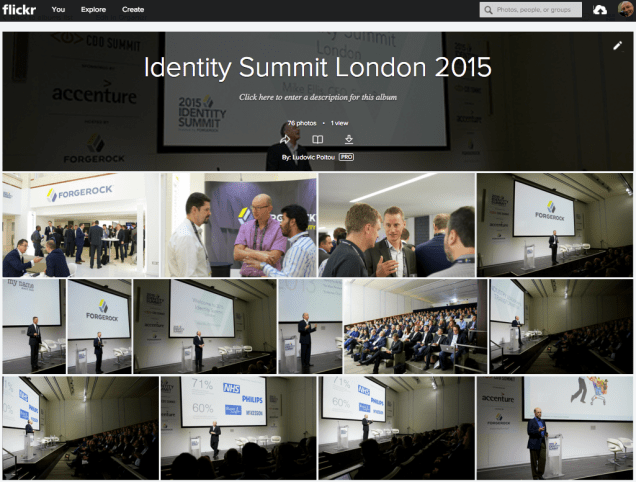
Identity Summit London 2015

Mike Ellis, ForgeRock CEO at London Identity SummitLast week, ForgeRockhosted the London edition of the Identity Summit 2015. It was a great event, very successful with over 200 attendees to discuss identity, digital transformation and IoT.ForgeRock Identity Summit London Attendees

My coworker Markus has published a detailed recap of the Summit, so I leave you with my usual picture gallery. Enjoy !

Screen Shot 2015-10-14 at 18.26.19There will be two other Identity Summits in November this year. One in Amsterdam on November 5, one in Düsseldorf on November 12. If you haven’t registered yet, it’s still time !

Learning Curve

A few years ago I had the pleasure to work with Rajesh Rajasekharan at Sun. He was an efficient trainer on Sun products and especially on Sun Directory Server. He recently joined ForgeRock and has started a series of blog posts and screen-casts on ForgeRock products and especially OpenDJ, but not only !

If you are getting started with the products or want to see demos of them, there’s no better place than to be on the “Learning Curve


Back from vacation

I’m back after a late summer break spent across France.  Sunset in North of France

Now it’s back to business full speed, to finish and deliver new major releases of our products by the end of the year.

I will also be traveling and attending a few events. The closer will be “Les Assises de la Sécurité” in Monaco, at the end of the month. If you’re attending the event, drop me a note. I’ll be happy to meet with you and discuss our products and solutions.

My views on ForgeRock Identity Summit

View of the ocean from Half Moon BayTwo weeks ago, I was in the mist of Half Moon Bay, attending the ForgeRock Identity Summit. This is the 3rd conference in the US and each year, the event becomes bigger, nicer and better. The location itself was amazing, sitting on the edge of the Pacific ocean, rocked (or lulled?) by the sounds of the waves.

ForgeRock User Group AttendeesOn the day before the main conference, we hosted a ForgeRock User Group, very well attended and had the opportunity to exchange with our customers, future customers and users about our product directions, and their experiences deploying the products. I’d like to thank the attendees for the great discussions, the sharing, and the excellent feedbacks that are definitely going to translate into product features and enhancements.

I was planning on writing a summary of the conference, but my coworkers did such a good job at it, that I encourage you to read their recap of Day 1 and recap of Day 2. So I leave you with my usual visual summary of the ForgeRock Identity Summit 2015, and all the photos that I’ve taken during the event.

18046252043_3aa9d0f7d3_m

OpenDJ Nightly Builds…

For the last few months, there’s been a lot of changes in the OpenDJ project in order to prepare the next major release : OpenDJ 3.0.0. While doing so, we’ve tried to keep options opened and continued to make most of the changes in the trunk/opends part, keeping the possibility to release a 2.8 version. And we’ve made tons of work in branches as well as in trunk/opendj. As part of the move to the trunk, we’ve changed the factory to now build with Maven. Finally, at the end of last week, we’ve made the switch on the nightly builds and are now building what will be OpenDJ 3, from the trunk.

For those who are regularly checking the nightly builds, the biggest change is going to be the version number. The new build is now showing a development version of 3.0.

$ start-ds -V
OpenDJ 3.0.0-SNAPSHOT
Build 20150506012828
--
 Name Build number Revision number
Extension: snmp-mib2605 3.0.0-SNAPSHOT 12206

We are still missing the MSI package (sorry to the Windows users, we are trying to find the Maven plugin that will allow us to build the package in a similar way as previously with ant), and we are also looking at restoring the JNLP based installer, but otherwise OpenDJ 3 nightly builds are available for testing, in different forms : Zip, RPM and Debian packages.

OpenDJ Nightly Builds at ForgeRock.org

We have also changed the minimal version of Java required to run the OpenDJ LDAP directory server. Java 7 or higher is required.

We’re looking forward to getting your feedback.