OpenDJ 2.4.3 is now available

Another revision of OpenDJ has just been released. OpenDJ 2.4.3 is an update release of the OpenDJ project and resolves several issues found around the External Change Log and the bundled database version. The version is built out of revision 7007 of the b2.4 branch of the code repository.

The full details about the release have been posted in the OpenDJ 2.4.3 Release Notes.

As usual, you can find every thing on the OpenDJ Downloads page:

In addition, some draft documentation for OpenDJ, and more specifically the Administration Guide, are now published (and regularly updated) on the OpenDJ project site.

Feedback is important to us and you can participate on the IRC channel, the mailing lists or join our community.

Enjoy !

Trends that we like !

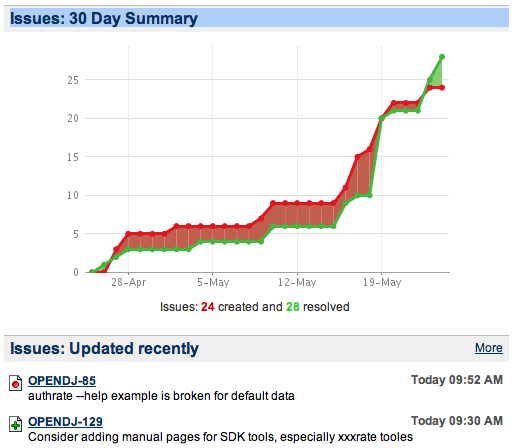
Bug trend on May 24th, for OpenDJ, the open source LDAP directory server in JavaWe (temporarily ?) have a pretty nice graph of our bug trend, on the issue tracker page of the OpenDJ project.
Kudos to Matt and Mark who’ve been really focusing on preparing two major areas of the project : the LDAP client SDK and the Core documentation for the whole project.

OpenDJ: Enabling the External Change Log on a single server

Yesterday, I described how easy it is to enable Multi-Master Replication between 2 instances of OpenDJ. One of the nice thing with OpenDJ replication, is that all changes are also publicly available (subject to access control) through LDAP under the cn=changelog suffix, also nick-named the External Change Log.

But the command to enable replication and thus the External Change Log requires 2 servers. So what if you want to enable the External Change Log on a single server ?

Note that this is not a fully supported procedure, but is handy for unit testing against the External Change Log. In production environment, you will have multiple servers for high availability and thus the External Change Log will be automatically configured.

Well you cannot use the dsreplication command, but you can configure the OpenDJ instance with the dsconfig utility.

$ bin/dsconfig create-replication-server -h ldap1.example.com -p 4444 \
  -D "cn=directory manager" -w secret12 -X -n \
  --provider-name "Multimaster Synchronization" --set replication-port:8989 \
  --set replication-server-id:2 --type generic
  
$ bin/dsconfig create-replication-domain -h ldap1.example.com -p 4444 \
  -D "cn=directory manager" -w secret12 -X -n \
  --provider-name "Multimaster Synchronization" --set base-dn:dc=example,dc=com \
  --set replication-server:ldap1.example.com:8989 --set server-id:3 \
  --type generic --domain-name example_com

If you want to be able to join this server in a replication topology, you should also create the global administrator’s entry. If you do so, then you will be able to use the dsreplication enable command as illustrated here.

$ bin/dsframework create-admin-user -X -h ldap1.example.com -p 4444 \
  -D "cn=Directory Manager" -w secret12 --userID admin --set password:password

Once enabled, you can read or search the changes with ldapsearch or other LDAP clients :

$ bin/ldapsearch -D cn=directory\ manager -w secret12 -h ldap1.example.com -p 1389 \
  -J "1.3.6.1.4.1.26027.1.5.4:false:;" -b "cn=changelog" '(objectclass=*)'
dn: cn=changelog
cn: changelog
objectClass: top
objectClass: container

# Public changelog exchange control(1.3.6.1.4.1.26027.1.5.4): dc=example,dc=com:0000012fd9bdf863000300000001;
dn: replicationCSN=0000012fd9bdf863000300000001,dc=example,dc=com,cn=changelog
targetDN: cn=a,ou=people,dc=example,dc=com
changeNumber: 0
changes:: b2JqZWN0Q2xhc3M6IHBlcnNvbgpvYmplY3RDbGFzczogdG9wCmNuOiBhCnNuOiBhCmVudH
 J5VVVJRDogNWQzMTNlY2UtYjY4Mi00MDFiLTg2NmYtM2NiZWNlMWNjNTJjCmNyZWF0ZVRpbWVzdGFtc
 DogMjAxMTA1MTAxMTQ5NTZaCmNyZWF0b3JzTmFtZTogY249RGlyZWN0b3J5IE1hbmFnZXIsY249Um9v
 dCBETnMsY249Y29uZmlnCg==
changeType: add
changeTime: 20110510114956Z
objectClass: top
objectClass: changeLogEntry

# Public changelog exchange control(1.3.6.1.4.1.26027.1.5.4): dc=example,dc=com:0000012fd9be46af000300000002;
dn: replicationCSN=0000012fd9be46af000300000002,dc=example,dc=com,cn=changelog
targetDN: cn=a,ou=people,dc=example,dc=com
changeNumber: 0
changes:: YWRkOiBkZXNjcmlwdGlvbgpkZXNjcmlwdGlvbjogTmV3IG9uZQotCnJlcGxhY2U6IG1vZG
 lmaWVyc05hbWUKbW9kaWZpZXJzTmFtZTogY249RGlyZWN0b3J5IE1hbmFnZXIsY249Um9vdCBETnMsY
 249Y29uZmlnCi0KcmVwbGFjZTogbW9kaWZ5VGltZXN0YW1wCm1vZGlmeVRpbWVzdGFtcDogMjAxMTA1
 MTAxMTUwMTZaCi0K
changeType: modify
changeTime: 20110510115016Z
objectClass: top
objectClass: changeLogEntry

Note: the search above uses the “Cookie Control” which is the optimized way to search the External Change Log. The value “;” means that the “cookie” is unknown, and therefore the search starts from the first change. If you want to continue from the last change received, provide the string value that is either in the ChangeLogCookie operational attribute (returned if asked for) or the comment before the change itself.

OpenDJ: Quick Replication setup

OpenDJ Servers Replication

As we develop OpenDJ, we spend a lot of time testing, whether it’s a new feature or a correction to an existing one. We usually write some unit tests to validate the code and then some functional tests to check the feature from a “user” point of view. While the unit tests are typically run with a single server, the functional or integration tests are run with configurations that match our customers deployment. And one of the given fact for any directory service deployment with OpenDJ that I’m aware of, is that the service is made of two or more OpenDJ directory servers with Multi-Master Replication enabled between them.

Setting up Multi-Master Replication with OpenDJ is quite easy and I’m going to demonstrate it here:

Lets assume we want to install 2 OpenDJ servers on the following hosts : ldap1.example.com and ldap2.example.com. For simplicity and because for test we avoid running tests with root privileges, we will configure the server to use port 1389 and 1636 for LDAP and LDAPS respectively.

On ldap1.example.com

$ unzip OpenDJ-2.4.2.zip
$ cd OpenDJ-2.4.2
$ ./setup -i -n -b "dc=example,dc=com" -d 20 -h ldap1.example.com -p 1389 \
  --adminConnectorPort 4444 -D "cn=Directory Manager" -w "secret12" -q -Z 1636 \
  --generateSelfSignedCertificate

Do the same on ldap2.example.com, the parameters being the same except for the -h option that should be ldap2.example.com

Now, you have 2 instances of OpenDJ configured and running with 20 sample entries in the suffix “dc=example,dc=com”. Let’s enable replication:

$ bin/dsreplication enable --host1 ldap1.example.com --port1 4444\
  --bindDN1 "cn=directory manager" \
  --bindPassword1 secret12 --replicationPort1 8989 \
  --host2 ldap2.example.com --port2 4444 --bindDN2 "cn=directory manager" \
  --bindPassword2 secret12 --replicationPort2 8989 \
  --adminUID admin --adminPassword password --baseDN "dc=example,dc=com" -X -n

And now make sure they both have the same data:

$ bin/dsreplication initialize --baseDN "dc=example,dc=com" \
  --adminUID admin --adminPassword password \
  --hostSource ldap1.example.com --portSource 4444 \
  --hostDestination ldap2.example.com --portDestination 4444 -X -n

For my daily tests I’ve put the commands in a script that I can run and will deploy 2 servers, enable replication between them and initialize them, all on a single machine (using different ports for LDAP and LDAPS).

Now if you want to add a 3rd server in the replication topology, install and configure it like the first 2 ones. And join it to the replication topology by repeating the last 2 commands above, replacing ldap2.example.com with the hostname of the 3rd server. Need a 4th one ? Repeat again, keeping ldap1.example.com as the server of reference.

More OpenDJ Tips…

I’ve already mentioned that Mark Craig has joined ForgeRock and started to blog about OpenDJ.

Here’s a few tips he’s recently posted about OpenDJ :

I’m sure there are more to come.

If you’re not following Mark’s blog feed yet, you should !

LDAP Advanced Administration for Enterprises…

OpenDJ directory server has one default administrator that can manage all aspects of the server.

In an earlier post, I’ve described how to create multiple administrative accounts in OpenDJ, and in another one, I’ve talked about the Privilege system and how it can be used to tailor the administrative roles of each account.

In most enterprises, administrators are usually employees and therefore have their own entries and password. For auditing purpose, security processes require that a change or an administrative task on the directory be done as the true person and not the administrative account. But often there are multiple administrators, and they can change role frequently. So what is the best practice for granting employees some administrative privileges ?

An efficient and manageable way  is to create an Administrators’ group and grant the privileges to all members of that group. When an employee, is no longer administrator, simply remove him from the group and he will loose all privileges associated. Likewise, adding a new administrator is just adding a member in the group.

With OpenDJ, this can be done with 2 simple entries : a group and a privilege collective attribute subentry.

The Group :

dn: cn=Administrators,ou=Groups,dc=example,dc=com
objectClass: groupOfNames
objectClass: top
description: LDAP Administrators Group
cn: Administrators
member: uid=ludo,ou=People,dc=example,dc=com
member: uid=Matt,ou=people,dc=example,dc=com

The Collective Attribute Subentry :

dn: cn=Administrators Privilege,dc=example,dc=com
objectClass: extensibleObject
objectClass: collectiveAttributeSubentry
objectClass: top
objectClass: subentry
cn: Administrators Privilege
ds-privilege-name;collective: config-read
ds-privilege-name;collective: config-write
ds-privilege-name;collective: ldif-export
ds-privilege-name;collective: modify-acl
ds-privilege-name;collective: password-reset
ds-privilege-name;collective: proxied-auth
subtreeSpecification: {base "ou=people", specificationFilter
  "(isMemberOf=cn=Administrators,ou=groups,dc=example,dc=com)" }

How does it work ?

Collective Attributes is a standard based LDAP functionality that allows to define attributes and value that are defined once and appear in all entries that match the subtreeSpecification. Collective Attributes are defined in RFC 3671. For those who are familiar with Sun Directory Server’s Class Of Service, Collective Attributes provide a similar function, but based on industry approved standard.

OpenDJ collective attributes feature supports a few extensions to facilitate their use.

First, the standard way to define a collective attribute is to define it in the schema with a “c–” prefix. With OpenDJ, any existing attribute can be defined as collective with the ;collective attribute option.

Second, the scope of a Collective Attribute subentry as defined by the standard is a subtree, but the only filter possible is to specify the object class it applies to. We’ve extended the specificationFilter to accept an arbitrary LDAP filter, allowing a finer grained control of which entries are targeted.

In the example above, the filter is used to restrict the Privilege Collective Attribute subentry to apply only to entries that have the isMemberOf attribute with the value “cn=Administrators,ou=Groups,dc=example,dc=com”.

IsMemberOf is an operational read-only attribute (virtual) that is a back-link to the groups a user belongs to. OpenDJ does support the isMemberOf attribute for static groups, nested static groups and dynamic groups.

The subtreeSpecification also contains a base “ou=people” to restrict the targeted entries to the ou=people subtree. There are additional field allowed in the subtreeSpecification to indicate a depth in the tree for example.

As a result, collective attribute subentries, combined with groups, provide a flexible way to “inject” attributes and values to a specified set of entries, either to grant them specific privileges like in our example, or to decorate entries based on some common properties.

This said, remember that privileges are set in addition to the Access Controls. So giving a user the password-reset privilege for example, will be useless if there is no ACI allowing him or her to modify the userPassword attribute of other users. Granting access through an ACI to a group is as simple as using groupdn=”ldap:///cn=Administrators,dc=example,dc=com”;  to designate the authorized identities.

A new release of OpenDJ : 2.4.2

We’ve just pushed another consolidation release of OpenDJ, the open source Directory services in Java, resolving a number of issues around the External Changelog and multi-master Replication, resulting in a more efficient and more reliable service, especially after network outages.

The full details about the release have been posted in the OpenDJ 2.4.2 Release Notes.

As usual, you can find every thing on the OpenDJ Downloads page:

Enjoy !

Linux and Unix LDAP clients and RFC2307 support

Quite often when one tries to migrate data from a directory server to another, small differences are discovered that prevent a direct and smooth migration. One of the most common issues when migrating from OpenLDAP or other Linux centric directory server to OpenDJ is around the schema for NIS, or the RFC 2307.

Before we dive into the core of the problem, let’s describe the symptoms:

Part of migrating from one directory to another consist of exporting the data to a common textual format, most likely LDIF, and import it in the new server. If you try to import some data in OpenDJ and it rejects entries as invalid with messages like the one just below, then you’ve just hit a schema issue with RFC 2307.

LDAP: error code 65 – Entry cn=MyGroup,ou=groups,dc=example,dc=com violates the Directory Server schema configuration because it does not include a structural objectclass.  All entries must contain a structural objectclass

Why a schema issue ?

Well, RFC 2307, “An Approach for Using LDAP as a Network Information Service” was published as an experimental RFC in 1998. As Unix vendors started to use it, they found a few issues which were addressed in an internet draft nicknamed rfc2307bis (the latest version can be found here). Solaris and HP-UX started to use this later schema, while Linux sticked to the official RFC.

One of the main difference between the RFC and the internet draft, is the PosixGroup object class definition that was changed from Structural to Auxiliary, hence the failure to import an entry defined with the RFC 2307 schema into a server supporting the rfc2307bis schema.

So what to do if I want to successfully import my data ?

There are 2 options : Fix the data to be compliant with rfc230bis schema or configure OpenDJ schema to be strictly RFC2307 compliant.

Fixing the data is quite simple, but requires basic knowledge of LDIF.

Since in rfc2307bis the posixGroup is Auxiliary, the entries are missing a Structural object class to be valid. The simplest way to fix that is to add the namedObject Structural object class.

dn: cn=MyGroup,ou=Groups,dc=example,dc=com
cn: MyGroup
objectClass: top
objectClass: posixGroup
objectClass: namedObject
gidNumber: 1001
description: My Group
memberUid: 1
memberUid: 10

Make sure you change all group definition and you can now import the data to OpenDJ.

Linux pam_ldap has full support for RFC2307bis. You just need to update the /etc/pam_ldap.conf file with the following line :

nss_schema rfc2307bis

Now, if you prefer to remain strictly compliant with RFC 2307, you need to change the schema of the OpenDJ server. Basically, you just need to stop the server, remove the 04-rfc2307bis.ldif file from the config/schema/ directory (save it in case you need it later) and add in the config/schema/ directory, the 04-rfc2307.ldif file. You can now import the data in OpenDJ.

This 04-rfc2307.ldif file is not part of the current distribution of OpenDJ, but we will add it pretty soon, however not as the default schema.

New releases of OpenAM and OpenDJ !

It’s the happy hour, with a double release day at ForgeRock.

OpenAM 9.5.2 has just been released, along with the J2EE Agents 3.0.3 and are now available for downloads from ForgeRock. You can find the release details in the Release Notes.

OpenDJ 2.4.1 has also been released today. The patch release can be found on the Downloads page in various forms: Java WebStart Installer, Zip package or SVR4 package. The Release Notes have been posted on the Documentation wiki.

Happy birthday IzPack

IzPack, the open source, Java based, cross-platform packager installer project is celebrating its 10th birthday with 2 releases and an impressive list of companies using the technology.

In OpenDJ, we have our own Java based (Java WebStart based) installer, but if I had to redo it, I would definitely pick IzPack to build it, for its easiness, cross-platform support and great look and feel.

Long live to IzPack !

Upgrading from OpenDS to OpenDJ

OpenDJ 2.4.0 was released a couple of months ago, and we’re seeing a lot of interest for it, especially from people who’ve already been evaluating OpenDS.

It is possible, and very easy, to upgrade from OpenDS 2.x to the latest version of OpenDJ. Here’s the easiest and more error-proof way.

First start by downloading the latest version of OpenDJ from ForgeRock web site. Currently the most recent release is OpenDJ 2.4.0, but nightly builds of coming OpenDJ 2.5.0 are also available. While you can run the upgrade through the Java web start installer, I recommend that you download the Zip package and run the upgrade from the command line.

Download and/or copy the OpenDJ zip package on the machine which has the instance to upgrade. Do not unzip it.

Go in the directory of the instance to upgrade:

cd /local/OpenDS2.2/

From that place, run the OpenDS 2.2 upgrade command :

./upgrade

The first question you’re asked is to confirm you plan to do an upgrade, so press the <Enter> key

The provide the full absolute path to the OpenDJ zip package, for example : /tmp/OpenDJ-2.4.0.zip

And then continue with the Upgrade program.

Should some customization of the schema or the configuration failing to be upgraded, the Upgrade program will stop and ask you what you want to do. You can review the details and decide to abort or continue the upgrade.

If you’re not sure about what to do, please consider continuing the upgrade. All files and customizations are preserved under the history directory and you can review them and decide if you want to try to reconfigure or not the upgraded server.

And do not forget to rebuild the dn2id index after the upgrade, as there’s been a change of format in this system index, to correct a defect and improve space efficiency.  To do so, stop the upgraded server and run the rebuild-index command :

bin/rebuild-index <some options> -i dn2id -b "<suffix>"

If you have a replicated environment, you can upgrade all the servers, one after the other, without interrupting the service nor changing anything in the replication configuration. The upgrade of a single server should take less than 5 minutes.

Prior to running an upgrade, we recommend you take a full backup of the server. A quick way to do this with small databases, is to stop the server and just fully copy it to another location. You can run the upgrade and then move back the copy in place if something didn’t run as expected.

Enjoy.

Update on Feb 27: Mention the need to rebuild the dn2id index. This was described in the 2.4.0 release notes, but was missing here.

Update on June 3: When upgrading to OpenDJ 2.4.2 or later, it is necessary to run a simple script against the OpenDS or OpenDJ instances before running the upgrade command. This script is patching a file used for the upgrade to detect schema changes. More details are available in the OpenDJ 2.4.2 Installation Guide.

1 Year Old and 1 New Architect

ForgeRock is exactly ONE year old today. As we’re a distributed and quite global company, we’re not going to blow the candle on the cake today. But I’m sure next time we meet, we’ll have one as nice as the one we had during our last company meeting in Faro, Portugal.

Also today is the first day at ForgeRock of Matthew Swift, as Architect for the OpenDJ project, growing the forces at the ForgeRock Grenoble Engineering Center. Matthew comes from Sun (Oracle) where he was leading the development of the core of OpenDS, as well as the LDAP Client API. He has been doing interesting work with regards to performances with the OpenDS server (he’s the one who provided me with nice numbers to present), and its reliability. Matthew has several years of experience building LDAP and Directory related products as well as Java development, for Sun, Bloomberg and Isode. He’s bringing his talent and energy back to the open source project and will help make OpenDJ an even stronger and better product.

I’m really delighted to work with Matthew again.

And what a great day today !

Directory Administrative Accounts – cont.

In a previous post, I’ve explained how to create multiple administrative accounts in the OpenDJ directory service. Today we’re going to look at restricting what applications can do with these administrative accounts.

In the OpenDJ directory service, there are 2 types of authorization systems :

  • Privileges control who can perform which administrative tasks : backup, restore, stop and restart of the server, managing acl…
  • Access Controls Lists govern the access to the data through LDAP operations.

Most operations involving sensitive or administrative data require that the user has both the privilege and authorization. This allows finer-grain authorization for specific data related action such as managing acl or reseting passwords.

The Privilege SubSystem

Privileges are assigned to users and apply globally to the directory service. Any user can be granted or denied any privilege and by default only the RootDN users are assigned a default set of privileges.

That set of privileges assigned to RootDN users is defined by the “default-root-privilege-name” property, which can be listed or modified using the dsconfig command.

To list the current default privileges assigned to all RootDN users :

bin/dsconfig -h localhost -p 4444 -X -D “cn=directory manager” -j /var/tmp/dmpassfile -n get-root-dn-prop

Property                    : Value(s)
----------------------------:--------------------------------------------------
default-root-privilege-name : backend-backup, backend-restore, bypass-acl,
                            : bypass-lockdown, cancel-request, config-read,
                            : config-write, disconnect-client, ldif-export,
                            : ldif-import, modify-acl, password-reset,
                            : privilege-change, server-lockdown,
                            : server-restart, server-shutdown, subentry-write,
                            : unindexed-search, update-schema

To make sure that all searches are done with proper indexes, you may want to remove the privilege to all Administrative Accounts to perform unindexed searches :

bin/dsconfig -h localhost -p 4444 -X -D “cn=directory manager” -j /var/tmp/dmpassfile -n set-root-dn-prop –remove default-root-privilege-name:unindexed-search

Note: Removing this privilege to all Administrative accounts including the default “cn=Directory Manager” may have side effects for certain internal operations such as group membership, referential integrity…

Whenever adding a new Administrative Account under the “cn=Root DNs,cn=config” container, it automatically inherits from those privileges. But each administrative account can then be denied or added specific privileges by adding values of the “ds-privilege-name” attribute directly in the user entry, in the form of the privilege name or a Minus sign followed by the privilege name.

For example, I can make sure that my newly added Administrative Account is subject to access controls and cannot modify access controls lists, I modify the entry as followed :

Create a temporary file modAdminPrivileges.ldif with the following LDIF modification statement:

dn: cn=Second Admin,cn=Root DNs,cn=config
changetype: modify
add: ds-privilege-name
ds-privilege-name: -bypass-acl
ds-privilege-name: -modify-acl

And then apply it to the directory service with the following command :

bin/ldapmodify -h localhost -p 4444 -X -Z -D “cn=directory manager” -j /var/tmp/dmpassfile -f modAdminPrivileges.ldif

Using similar commands and different privileges, one could completely separate the administrative tasks and restrict each Administrative Account to its specific tasks.

But the great thing about privileges is that they can also be granted to regular users part of the Directory Information Tree, allowing them to become administrators for very specific tasks.

The complete list of privileges supported in OpenDJ 2.4 is below:

  • backend-restore: Ability to perform backend restore operations.
  • bypass-acl: Ability to bypass access control evaluation.
  • bypass-lockdown:Ability to bypass server lockdown mode.
  • cancel-request: Ability to cancel arbitrary client requests.
  • config-read: Ability to read the server configuration.
  • config-write: Ability to update the server configuration.
  • data-sync: Ability to participate in a data synchronization environment.
  • disconnect-client: Ability to terminate arbitrary client connections.
  • jmx-notify: Ability to subscribe to JMX notifications.
  • jmx-read: Ability to perform read operations via JMX.
  • jmx-write: Ability to perform write operations via JMX.
  • ldif-export: Ability to perform LDIF export operations.
  • ldif-import: Ability to perform LDIF import operations.
  • modify-acl: Ability to modify access control rules.
  • password-reset: Ability to reset user passwords.
  • privilege-change: Ability to change the set of privileges for a user, or to change the set of privileges automatically assigned to a root user.
  • proxied-auth: Ability to perform proxied authorization or request an alternate authorization identity.
  • server-lockdown: Ability to lockdown a server.
  • server-restart: Ability to request a server restart.
  • server-shutdown: Ability to request a server shutdown.
  • subentry-write: Ability to perform write operations on LDAP subentries.
  • unindexed-search: Ability to perform an unindexed search
  • update-schema: Ability to update the server schema.

Multiple Directory Administrative Users

Most of LDAP directory servers configure a single well known directory administrative account (cn=Directory Manager [,dc=example,dc=com]) which has full access to everything. While there is a need to have one special user to bootstrap the server, we are too often seeing that special account being used by all applications that have specific administrative needs : the provisioning application, the email management application, …

OpenDJ has different mechanisms to define multiple administrative accounts, but today, I’m going to focus on the “Root DNs” i.e. defining multiple Directory Managers.

The default administrative account is “cn=Directory Manager”, and is stored in the configuration under the “cn=Root DNs,cn=config” container entry.

Adding another administrative account is as simple as adding another entry under that container, with one specific objectClass : ds-cfg-root-dn-user.

Create a file newAdmin.ldif

dn: cn=Second Admin,cn=Root DNs,cn=config
cn: Second Admin
objectclass: top
objectclass: person
objectclass: organizationalPerson
objectclass: inetOrgPerson
objectclass: ds-cfg-root-dn-user
sn: Second Admin
ds-cfg-alternate-bind-dn: cn=Admin2,dc=example,dc=com
ds-pwp-password-policy-dn: cn=Root Password Policy,cn=Password Policies,cn=config
userPassword: password42

ldapmodify -a -D cn=Directory Manager -j /var/tmp/dmpassfile -f  newAdmin.ldif

Processing ADD request for cn=Second Admin,cn=Root DNs,cn=config
ADD operation successful for DN cn=Second Admin,cn=Root DNs,cn=config

If you prefer, you can choose not to set the password in the LDIF file, but set it in a secure way afterwards :

$ bin/ldappasswordmodify -p 1389 -D “cn=directory manager” -j /var/tmp/dmpassfile -a “”cn=Admin2,dc=example,dc=com” -N /var/tmp/newpw
The LDAP password modify operation was successful

Where /var/tmp/dmpassfile contains the password for “cn=directory manager” and /var/tmp/newpw the new password for Admin2.

Did you notice the “ds-cfg-alternate-bind-dn” attribute in the definition of the new administrative account ? This enables to authenticate to the directory server with the DN value specified in this attribute, while the entry still has a DN and is located under the “cn=config” suffix.

So now, don’t hesitate to create different administrative accounts for the various applications that need special access to the directory.

In a follow-up post, I will explain how to restrict what those administrative accounts can do in the OpenDJ directory service.

OpenDJ 2.4.0 has been released

I’m very pleased to announce the first full release of our Open source Directory services for the Java platform : OpenDJ 2.4.0.

Based on open source and open standards, OpenDJ is a new LDAPv3 compliant directory service, providing a high performance, highly available and secure store for the identities managed by enterprises. Its easy installation process, combined with the power of the Java platform makes of OpenDJ the simplest and fastest directory server to deploy and manage.

Choosing OpenDJ as an enterprise directory service has the following benefits :

  • Lower the cost of ownership : Delivers more performance while consuming less resources (disks, memory and CPUs). Simplifies the administrative tasks by automating them.
  • Platform independence : Runs on any platform that supports Java 6, including virtualized environments.
  • High Availability : Supports deployment of multiple servers in a multi-master replication topology, providing failover and disaster recovery.
  • Secure data store : Supports different levels of authentication and authorization. Protects passwords through encryption and extensive policies.
  • Monitoring and Alerts : Can be monitored by 3rd party applications using SNMP and JMX. Supports custom alerts to inform of specific events in the service.
  • Interoperability : Supports all LDAPv3 standard specifications, most of LDAPv3 standard and experimental extensions as well as some vendor specific extensions, easing integration with applications.

After a little bit over 2 months of beta testing, OpenDJ is now ready for use into production. And with this release, the OpenDJ project delivers the features announced on OpenDS roadmap and plans to continue the development of the project in a true open and collaborative way.

OpenDJ 2.4.0 can be downloaded from our downloads page, or installed through Java WebStart by just clicking here. You can find more details about it in the Release Notes.

Enjoy !

And send us your feedback, on the OpenDJ mailing list (subscribe here) or on #opendj IRC channel.